

I often hear this question in my coaching sessions: I actually know exactly what I need to do. So why don’t I just do it?
From directors, management team members and entrepreneurs. People who are well aware that they need to have that conversation, delegate more or set their boundaries more often.
They know.
And yet they don’t.
We’re quick to turn that into a problem with motivation or discipline. Another book. Another training course. Another New Year’s resolution.
But knowing is only the beginning.
To me, change looks like this:
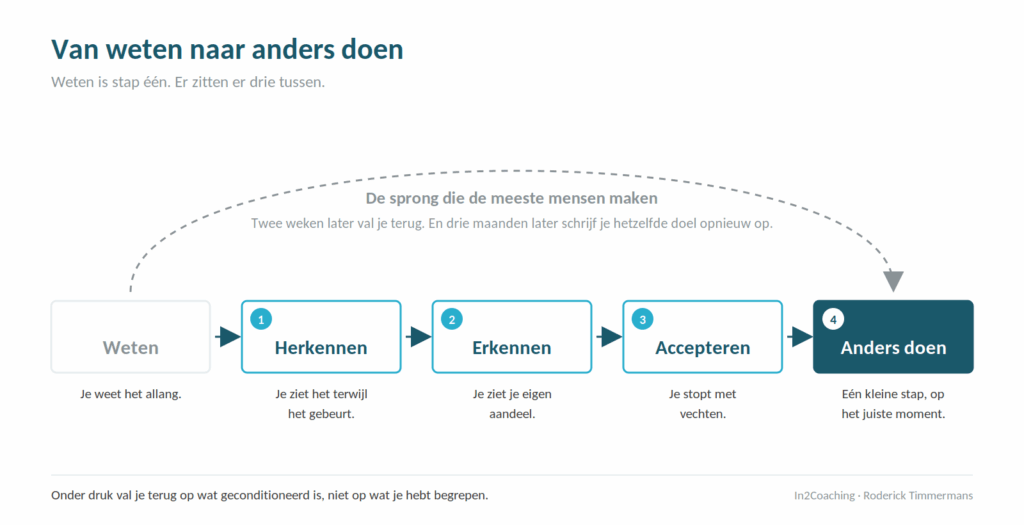
1. Recognising
Don’t find yourself thinking in the car afterwards: ‘Bloody hell, I’ve done it again.’
But seeing it as it happens.
I’m going to give the answer again now.
I’d like to take this on.
I find myself defending myself.
I want to get rid of this tension.
It is precisely at that moment that the opportunity arises to make a different choice.
2. Acknowledgement
Things are starting to get a bit less comfortable here.
There’s a world of difference between: ‘My team isn’t taking enough responsibility.’
And: I reply so quickly that my staff hardly have to think for themselves.
In the first sentence, the problem lies with the other person.
In the second one, you come into the picture yourself. Ask yourself the question: ‘Why is this happening to me?’
And that is precisely where your influence lies.
3. Accept
Acceptance does not mean that you approve of the behaviour.
It means you stop judging yourself for it.
Why am I doing this again?
I really ought to know better.
Apparently, I can’t do this.
Then, all of a sudden, you’ve got two problems: the behaviour itself and your judgement of it.
Acceptance means looking at what is, so that you can work with it.
4. Do it differently
Only then does new behaviour emerge.
And it doesn’t have to be big.
Not: From now on, I’m going to delegate more effectively.
However: If someone comes to me with a problem tomorrow, I won’t give an immediate answer. I’ll ask one question first.
Short and to the point.
Exactly at the moment when you would normally fall back into your old pattern.
Why knowing isn’t enough
We often go straight from realising something to thinking: ‘I really must do this differently now.’
That might work for a while.
Until things get hectic. Or exciting. Or you’re tired.
Then the old behaviour returns.
Not because you don’t know enough.
But it is under pressure that what has truly become ingrained becomes apparent.
That’s why, when it comes to coaching, I’m less interested in what someone actually understands.
I’d like to know: What do you do when the tension rises?
That’s usually where the real work lies.
So if you’ve known for some time what you ought to do, why not ask yourself four other questions:
- When will my period start?
- What is my share?
- Can I stop judging myself for it?
- What specific things can I do differently next time?
Because, for me, personal leadership isn’t about knowing what you ought to do.
It shows in what you do when things get tense.
Does this sound familiar, and do you find yourself getting stuck at the same point time and time again? Please feel free to send me a message. Then we’ll see where you’re getting stuck in the transition from knowing to doing.



 English
 Dutch