

“We have a communication problem within the management team.”
I hear this a lot. And what happens next is almost always the same. A new meeting format is introduced. Roles are clarified. A team day is planned, usually with an external facilitator and an afternoon of Post-it notes.
Everyone goes home feeling relieved. And six weeks later, the same issue is back on the table – in other words. That’s because that wasn’t where the problem lay.
Overt and covert currents
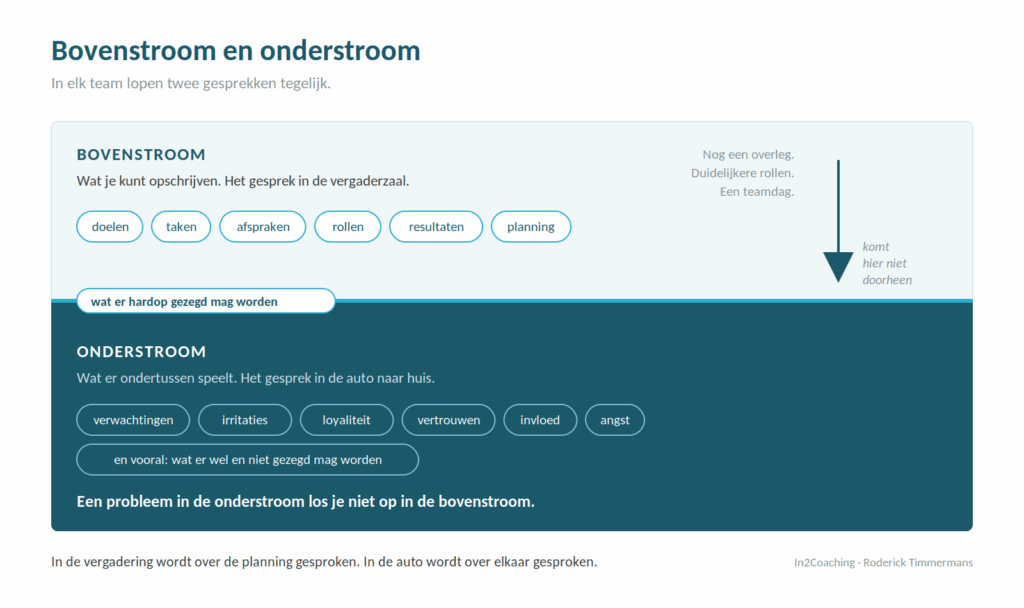
In each team, two conversations are taking place at the same time.
The upstream These are the things you can write down: objectives, tasks, commitments, roles, outcomes, and the schedule. This is the discussion taking place in the meeting room.
The undercurrent This is what’s going on in the meantime: expectations, frustrations, loyalty, trust, influence, fear, and, above all, what can and cannot be said. This is the conversation in the car on the way home.
The schedule is discussed at the meeting. People talk about each other in the car.
If a problem lies in the undercurrent, you can keep coming up with endless solutions in the surface current. They won’t work, because they’re not addressing the same issue.
Why leaders still opt for the upstream route
It’s not out of a lack of willingness. The upstream route is simply more appealing.
It’s visible, predictable and safe. You can tick it off your list. Introducing a new meeting schedule feels like taking action. It results in a decision, an email – something you can show to your own manager.
The conversation in the undercurrent doesn’t lead to any of that. It’s uncomfortable, the outcome is uncertain, and you don’t know in advance whether things will get better or worse first.
So another appointment won’t solve the problem. It just makes it easier to keep putting off the real conversation.
Five signs that it’s in the undercurrent
- The decision is taken during the meeting and is then reversed behind the scenes.
- Everyone agrees, yet nothing happens.
- The same topic comes up for the third time, each time in different words.
- People are often talked about, but rarely talked to.
- The meetings go on for a long time and few decisions are taken.
If you recognise three or more of these, then a tighter schedule isn’t the answer for you.
What, then?
It starts by describing what is happening, rather than what ought to be happening.
Not: we need to communicate more openly with one another. But: it strikes me that this is the third time we’ve discussed this, and that every time we agree, yet nothing changes afterwards. What’s going on here?
That’s an awkward sentence. It’s also the shortest route.
And then comes the hardest bit: staying silent. Because after a comment like that, there’s a silence, and that silence feels like a problem. It isn’t. It’s the first time there’s space for what’s really going on.
Most managers aren’t bad at asking questions. They’re bad at staying silent afterwards. They fill the silence, suggest a direction, or lighten the mood. And with that, the conversation is back in the mainstream.
“I don’t have time for this”
This is the most common excuse for not having such a conversation. It sounds professional and everyone accepts it.
I asked a director the other day: ‘Don’t you have time? Or don’t you want to experience what happens if you do have that conversation?’
There was a brief silence. Then he said: ‘The second one.’
‘I don’t have time’ is almost always a convenient answer to an awkward question. And it’s costly. An underlying problem that’s left unresolved won’t cost you an hour; it’ll cost you months of slow decision-making, duplication of effort and people dropping out without anyone realising when it all started.
In conclusion
If your team is struggling with a problem that just won’t go away, the question is rarely whether you need a better structure.
The question is: what conversation should be taking place that is currently only happening in the car park? And who is going to start it?
The latter is not usually a team issue. It is a leadership issue.
Does this happen in your team? I work with management teams and senior management on exactly this sort of discussion. Send me a message, then we’ll have a look at it together.


 English
  Dutch
Dutch