

You've probably heard of them before: core quadrants. These are your unique core characteristics displayed in a schematic overview. A core quadrant gives great insight into yourself and others. And thus tools for personal leadership and better cooperation, for example with colleagues. In this blog, I explain how to draw up core quadrants and how to use them for your personal development.
How do you create your core quadrants?
Below is an example of a core quadrant with the core quality decisiveness. You can make such a core quadrant out of all your core qualities. Start by filling in wherever you like. If you come to an allergy first, start with that. Below the image you can read what each part means.
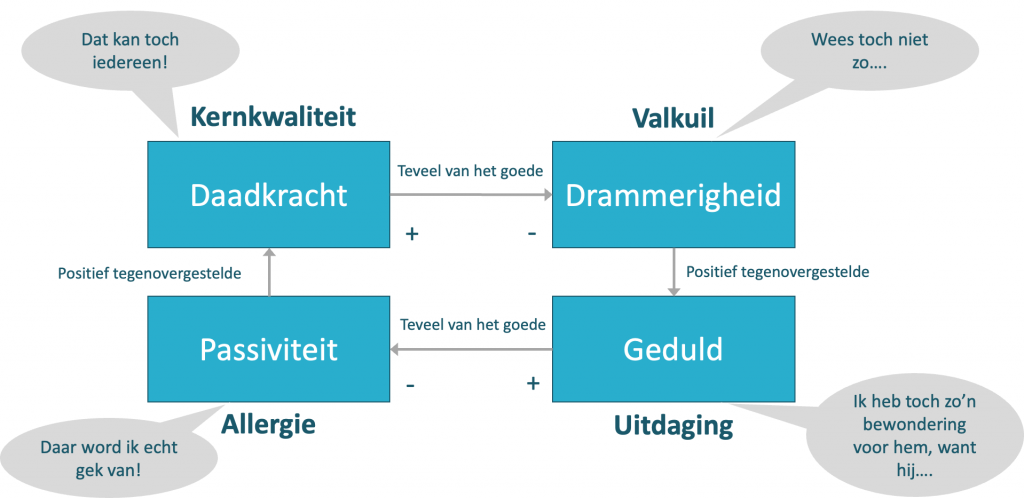
Core quality
About our own core qualities, we often say: 'But can't anyone do that?' We don't know any better, because they are innate. Unlike skills, which are learned. You can develop your core qualities or keep them hidden, but turning them on or off, you can't. Our core qualities also often overlap with our values, passions and talents.
✓ To discover your core quality, ask yourself: what positive trait typifies me? Think patience, commitment, stress-resistance or decisiveness.
Pitfall
A pitfall occurs when you go overboard with your quality. Too much of a good thing then results in negative behaviour. As shown in the illustration, too much decisiveness results in pushiness. People around you will then say, "Don't be so pushy.
✓ To discover your pitfall ask yourself: What reproach do I sometimes get? How do people perceive me when I am stressed?
Challenge
Your challenge is the opposite of your pitfall. With this trait, you prevent or reduce your pitfall. For example, nagging requires patience. A challenge is often also the behaviour that you admire in others, that you yourself lack or that others wish you had. If you are decisive yourself, you will benefit from a colleague with a lot of patience.
✓ To discover your challenge, ask yourself: What characteristic of others do I envy?
Allergy
Just like a quality, a challenge has a negative consequence when you commit too much of it. It results in a trait you like less about yourself and disdain in others. For example, too much patience results in passivity. So a decisive manager will be annoyed by a passive employee: this is his allergy.
✓ To discover your allergy, ask yourself: What behaviour of another irritates me immensely and is the negative opposite of my core quality?
Learning from core quadrants
The better you know your core quadrants, the better you can use your qualities. And the better you can develop yourself. Paying attention to your challenge, for example, will bring you more balanced.
Allergy as a teacher
Your allergy tells you which trait you could use more of: the corresponding challenge. If you are confronted with your allergy, chances are you will fall into your trap. So if you are annoyed by someone's passivity, you will quickly fall into pushiness. Being aware of this will help you avoid that.
You can use core quadrants both personally and for teams. In my conscious leadership courses, we work extensively with core quadrants and core qualities. You can read more about these courses here.
Source: The core qualities of the Enneagram - Daniel Ofman, Rita van der Weck-Captein


 English
  Dutch
Dutch