

Did you know that your breathing is one of the most important components for good health and more energy? In this blog, I share with you three breathing methods for better health, more energy and peace of mind.
For several years now, I have discovered the power of breathing and know that it is my main source of energy.
On average, you breathe 25,000 times a day, with your diaphragm causing your lungs to fill with air. Breathing affects your sympathetic (fight and flight) and parasympathetic (rest and recovery) nervous systems. Excessive breathing can lead to feeling stressed and reduced ability to recover. According to James Nestor many people suffer from chronic overbreathing, which can lead to headaches, fatigue and difficulty concentrating.
The impact of bad breathing
Excessive breathing can lead to less oxygen in your brain and a constant fight-and-flight mode. This also applies to athletes with low heart rate variability after exercise, hindering recovery. Mouth breathing at rest is bad for you, with possible consequences such as high blood pressure and sleep disturbances.
When you don't breathe properly, you 25-55% get less breath than when you breathe correctly.
What is good breathing?
Good breathing varies between rest and exertion. At rest, you breathe an average of 6 to 10 times per minute. During exercise, this varies depending on the intensity.
Breathing exercises
There are several breathing exercises to improve your breathing. You choose an exercise based on the goal you have. The Buteyko method and the 4-7-8 method can help you with stress and insomnia.
Intensive techniques such as those of Wim Hof can improve your stamina. Always be careful with intense exercise if you have health problems.
Connective breathing is a breathing technique that helps you reduce stress, tension and process trauma.
In short, good breathing makes a big difference to your health, stress levels and sports performance. Try different breathing techniques to find out what works best for you. As promised, below I share with you 3 breathing methods for better health, more energy and peace of mind.
- Power breath-method
To improve your breathing, try this breathing exercise to strengthen your lungs. Tony Robbins developed this exercise, partly based on scientific research, to generate energy.
The first step is to adjust your posture. Sitting upright allows your lungs to expand faster and more efficiently. Air can go in and out of the lungs and reach your bloodstream without being blocked or obstructed.
Make sure you fill your lungs completely by concentrating on filling your lungs like a paper bag. When you are ready to exhale, try to push all the air out of the bag.
By breathing deeply and in a specific way, you pump up your lymph nodes. As a result, if you do this breathing exercise for a fortnight, you can see a big positive change in your white blood cells. And, among other things, ensures an active immune system and an awake but relaxed state. The exercise consists of the following steps:
Step 1: Find a comfortable chair or place where you can sit upright.
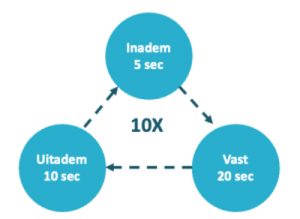
Step 2: Take 10 strong breaths in the next ratio: 1: 4: 2
Step 3: So inhale 1 second: hold for 4 seconds: exhale for 2 seconds. Or breathe in for 2 seconds: hold for 8 seconds: breathe out for 4 seconds. And if you were to inhale for 4 seconds, you would hold your breath for 16 seconds and exhale for 8 seconds.
Step 4: Repeat the above steps 3 times a day.
If you can do this 10 times, 3 times a day (morning, evening and before bed), you will notice a huge difference in your energy, clarity and ability to ward off disease.
What else is important to know about this exercise:
- Why breathe out twice as long as you breathe in? That ensures you remove toxins through your lymphatic system.
- Why hold for 4 times as long? This allows you to fully oxygenate your blood and activate your lymphatic system.
- When you breathe in, you may start deep in your belly, like a hoover clearing out all the toxins in the bloodstream.
- Inhale through your nose and exhale through your mouth.
- Work up slowly, never force and always breathe from your belly.
"Improper breathing is a common cause of ill health. If I had to limit my advice on healthier living to just one tip, it would simply be to learn to breathe correctly. There is no more powerful - or easier - daily exercise to promote your health and well-being than breathwork. "
- Andrew Weil, M.D.
- Box Breathing
One way to tackle stress is this breathing technique. It is called 'Box Breathing' - a stress-reducing technique used by none other than the U.S. Navy Seals. For them, it is a way to stay calm and focused, and this keeps them cheerful after intense combat or strenuous exercise. For us, the 'normal person', it is an easy mindfulness exercise to keep stress at bay. Besides, you only need a few minutes.
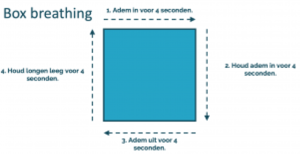
Box-breathing is a technique you can use to reduce stress. It is a simple technique that you can do anywhere, including at a desk or in a café. The technique consists of the following steps:
Step 1: Find a comfortable chair or place where you can sit or lie down.
Step 2: Inhale for 4 seconds.
Step 3: Hold the air in your lungs for 4 seconds.
Step 4: Exhale for 4 seconds, blowing all the air out of your lungs.
Step 5: Keep your lungs empty for 4 seconds.
Step 6: Repeat the above steps for 4 minutes, or longer until you are relaxed and focused again.
If you find this technique challenging to begin with, you can try counting to 3 instead of 4. Once you get used to the technique, you can choose to expand to 5 or 6 counts.
- Deep relaxation (4-7-8)
This breathing exercise is another one that is common in yoga and meditation circles. It is very effective in quickly normalising our oxygen to carbon dioxide, making it invaluable for overcoming stressful situations, fighting anxiety and panic attacks and falling asleep faster at night.
Do the 4-7-8 while sitting or lying down to get the most out of it. Clearing your mind (by meditating, for example) will help you get even more out of this simple breathing exercise.
Step 1: Breathe in slowly through your nose with your mouth closed for 4 seconds.
Step 2: Hold your breath for 7 seconds.
Step 3: Puff out your lips and exhale forcefully through your mouth. Use your back, chest and lower abdominal muscles to generate as much "exhalation force" as possible.
If the times are too long for you, try shortening them while keeping the ratios very close: e.g. 2-5-6. But try to work up to 4-7-8, as this is the optimal ratio to encourage the lungs to take in as much oxygen as possible when inhaling, while also releasing as much carbon dioxide as possible when exhaling.
That's it! These 3 breathing exercises are now a big part of my life and believe me; if you are overworked, overstressed or under-energised, you are probably not breathing properly and are carrying more negative energy than you realise.
Want more? Read here On Wim Hof breathing that helps you break through stress and fatigue.




 English
  Dutch
Dutch