
The six basic needs
Every human being has six basic needs. These are the drives that determine what you do. They are at the basis of all your motivations and are present in everything you undertake. Unconsciously, you spend all day filling these basic needs. Because they are the same for everyone, only each person fills them in a different way. Filling in the basic needs never stops and they never go away. You can fulfil or fill them temporarily, but almost immediately afterwards you experience a new need again. The moment a need is met, you are happy; if a need is not met, you experience a negative emotion.
Motivation
Needs are your basic desires. They make you move. Fulfilling your basic needs is not only about what you want, but also what you need. Everything you do, you do for a reason. And you find that reason in one of the six basic needs.
Common basic needs
Your values and norms, beliefs, strategies and desires may differ from those of others, but basic needs are the same for every person. Only their fulfilment is up to you. Sometimes that fulfilment helps you, but it doesn't have to. For example, you may drink alcohol, use drugs or smoke cigarettes to relax. Or maybe you do so by eating, having sex, shopping or reading books. The number of ways to fill your needs is endless.
Choice
How you fulfil your basic needs is entirely up to you. The trick is to be aware of that free choice. So how do you fill your needs as adequately as possible? The secret lies in adjusting your beliefs. By changing what you believe about yourself, you are able to create a new strategy so that you achieve different and better results.
These are the six basic needs that determine all our behaviour:
- Safety and security
- Variation
- Being important or valuable
- Love and connection
- Growth
- Contributing to the bigger picture
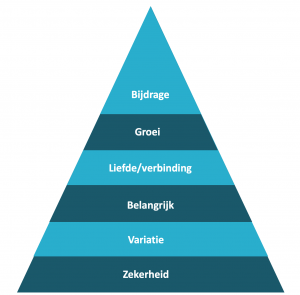
1. Need for safety and security
The first and most fundamental basic need is that of safety and the certainty that we can feel well. That we have food and drink and a roof over our heads. This need manifests itself in avoiding fear or pain and in pursuing as much pleasure as possible. In the case of a relationship, it manifests itself, for example, in trusting that the other person will not let you down. A negative interpretation of the need for security is, for example, controlling others.
The extent of the need for safety varies from person to person and can often be traced back to childhood. If safety was an issue in the past, chances are you will have a greater need for it later in life. Words that also belong to this basic need are: comfort, stability and predictability.
What do you do to feel good again when too much tension arises in your life?
2. Need for variety
We all need a certain amount of certainty and predictability, but eating the same thing every day is not nice either. Then it becomes too predictable and the need for variety arises. You achieve this by stretching emotional or physical limits; by exercises, surprises, challenges and uncertainties. People find variation, for instance, by playing extreme sports, using drugs or, in the case of a relationship, cheating. Another source of variation is problems. When something goes differently than expected, you often feel uncertainty.
Words associated with the basic need for variety: variety, anxiety, instability, change, chaos, refreshment, relaxation, surprise, challenge, problems, crisis.
Basic needs 1 and 2
The more safety and security we find within ourselves, the less dependent we are on the outside world to fulfil these basic needs. And the greater our need for variety. Because when our need for security and safety is met, we step out of our comfort zone more easily and do new things faster. Because we are less afraid and open to something new, we learn and discover more. And these are important factors for success.
In what ways do you fill your need for variety?
3. Need to be important or valuable
The third basic need is the need to be important or valuable. To feel seen, heard and recognised. To be needed and wanted. If all goes well, as a baby, your needs were met naturally. You only had to cry and one of your parents would come to see what was wrong with you. Later, needs were met less and less easily. This creates emotions: unmet needs. To avoid them, you developed behaviours as a child that help you fulfil your needs. Making jokes, for example. Or being obedient or clever, so that you are seen.
A pitfall in this basic need is the tendency to compare yourself to others. This can make you feel better or worse than others. If you focus too much on this comparison, you may experience problems connecting with others. This is because you then mainly see the differences instead of the similarities. Negatively, this leads to judging: putting the other person or yourself down, and to doubting whether you are good enough. An exercise is to start a conversation with acquaintances or strangers and consciously look for your similarities. How does that affect you and the other person?
Many people meet this basic need by pursuing careers. A problem at work or promotion that does not go through can then have a great effect on their self-esteem. Other ways of meeting this need: having a relationship or children, playing sports, getting tattoos or buying a fat Ferrari. Some people even derive self-worth, in negative ways, from a major problem they have, which they use to stand out and gain recognition.
Matching words include pride, important, standards, results, attitude, perfection, evaluation, discipline, competition, as well as words related to being rejected or being good enough.
How do you make yourself feel important?
4. Need for love and connection
Every person has the need to feel connected to their environment. You can achieve this through, for instance, a relationship, meditation, faith, a pet, family, friendship, a club or (sports) team. In doing so, it is important to know that you are only able to experience love for another when you can experience the feeling of love for yourself. And that beliefs about what it takes to feel love can hinder you from feeling loved.
This is because you make your own rules about how you recognise and value love, and about your ability to give and receive love. These rules or beliefs often originated in your childhood. Some people rarely experience love, but still feel connected to other people. Indeed, connectedness is sometimes a less threatening alternative to love. Think of someone who has lost his or her partner and takes a pet to feel connection with.
A negative interpretation of connection is having other people solve your problems, giving you attention and making you feel loved. Words for love and connection: together, united, connected and passionate.
When did you feel you were truly loved?
5. Need for growth
Everything you have or experience - your body, money, happiness, love - needs maintenance. Cultivation, development, expansion. Otherwise, it decays. That is, there is no moment when we can say, "That's how it is, I'll leave it like that and enjoy it. So even if your relationship, body, work and finances are in good shape, they need consistent care and growth. If you stop caring for them, they deteriorate until they 'die'. Think of relationships and friendships that are not invested in. These slowly bleed to death.
The need for growth can be fulfilled in many ways: growth in work, in wisdom, in self-love, in awareness, in sporting achievements. So it is possible to keep growing throughout life. Growth often involves variety; this is why learning new things outside your comfort zone is also so important.
In what ways do you make sure you really keep developing?
6. Need for contributions
Research shows that giving makes you happier than receiving. This is because it creates fulfilment. Because life is not just about yourself, but more importantly about the contribution you make to others and to the bigger picture. Contributing means that you give to others regardless of your own needs. That you think and share from abundance. You can do this through volunteering, helping your community or inspiring others. Therefore, those who focus on contributing will not easily feel pessimistic or bored. The same applies to companies: the most successful ones are able to contribute more and add more value than less successful ones.
Most (emotional) problems and sources of pain disappear when you focus on sharing and giving instead of receiving. Therefore, giving is an effective way to fulfil your other needs as well. Because when you focus on giving, then:
- be sure (basic need 1) that you are able to contribute: there is always a way you can do so
- things that go right or wrong alternate (basic need 2)
- feel valued (basic need 3) because by contributing you show that you are valuable.
- you experience growth (basic need 5) because giving asks you to go beyond your own needs
"The secret of living is giving"
- Tony Robbins
Crisis
We all create our own model of the world. As a result, the ways in which we fulfil our needs differ. For example, maybe you always want to be in control to give yourself a sense of security. Or you don't trust anyone and instead find security in a religion.
If you fail to fulfil a basic need in your usual way, you will experience a crisis. For example, if you fulfil your need to be valuable through a job and then get fired. You will then experience a loss of self-worth and look for other ways to fill this need again.
In what ways are you fulfilling your needs?
So how you fulfil basic needs varies from person to person. This can be both positive and negative. Filling your needs structurally in a positive way leads to growth. Filling needs negatively, on the contrary, leads to deterioration in mental and physical fitness.
According to coach and speaker Tony Robbins, behaviours that satisfy at least three basic needs can become addictive. For myself, this is my need for sports. Sports give me security That I feel fulfilled and mentally recharged afterwards; variation after sedentary work or being there for my children; a sense of importance thanks to recognition from those around me; link with both myself and my teammates; growth Because I notice that training makes me stronger or faster.
Sport, in my case, fulfils five of the six basic needs. Not surprisingly, then, I have become slightly addicted to it. This is a positive addiction. But addiction can also be negative, for instance when it comes to using drugs to fulfil your needs. Drug use then gives you variation by escape from negative feelings during sober periods; the security of feeling good after a shot; a temporary feeling of love or strong link with yourself or your surroundings.
Another negative example is addiction to violence. This fulfils the need to important to be by immediately being the most important person in someone's life when you put a gun to their head; the need for security because violence gives you control over the other; and the need for variation because violence creates new situations, challenges and problems. It also takes little effort to meet this need.
In what ways do you fulfil your basic needs? Do you do this mostly positively or sometimes in a negative way? And if you do it in a negative way, what would be more positive ways to fulfil the same need?
Achieving change and the basic needs
To achieve change, it is important to recognise which needs your behaviour is meeting. Change is only possible if you can still satisfy the same needs in another way. For instance, it makes little sense to tell someone who eats chips out of loneliness that this is unhealthy. Coming up with alternatives to break the loneliness is a much better idea. Because the six basic needs provide insight into your own behaviour, you are able to work towards meeting your needs in a more positive way.
Assignment
Download here for the Workbook the six basic needs. On this, you can write down your positive and negative fulfilment of the basic needs. You can also write down an alternative to your negative behaviour in the last column. Good luck!
 English
  Dutch
Dutch